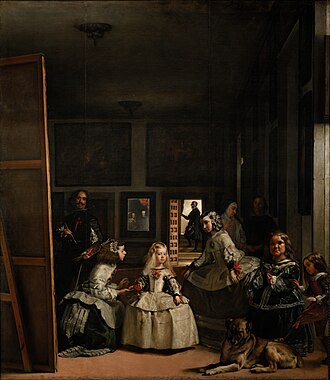
What is an atelier?
The studio is the school.
An atelier is a master painter's working studio that takes on a small number of students. They sweep the floor, prepare the panels, grind the colours — and, slowly, learn the craft by repeating the master's exercises and watching his hand. It is how painting was taught from the Renaissance to the late 1800s, and how a handful of schools still teach it today.
The word is French for “workshop,” but it names a relationship as much as a place. There is no curriculum committee, no semester structure, no degree at the end. There is a master, a few students, an easel each, and a long sequence of carefully ordered exercises that runs roughly four years from first cast drawing to finished portrait.
02Where it came from
Renaissance Florence
The atelier as we know it was forged in the bottega of fifteenth-century Florence. Verrocchio's workshop, where the young Leonardo da Vinci spent his apprenticeship, was at once a place of business and a school. Apprentices began as boys of twelve or thirteen, lived in the master's house, and earned the right to touch the master's panel only after years of grinding colours and copying drawings.
Cennino Cennini's Il Libro dell'Arte, written around 1390, records the curriculum: a year drawing with the silverpoint, six years grinding pigments and preparing grounds, six more painting in tempera and learning to handle gold.

Caravaggio · The Calling of Saint Matthew · 1599
03The French Academy
The system was formalised in 1648 when the Académie royale was established in Paris under Charles Le Brun. Study proceeded in a fixed order: drawing from engravings, then from plaster casts, then from the living model. Only after years of drawing was the student allowed to take up the brush. The grand prize was the Prix de Rome, a five-year pension at the French Academy in Rome where the winner copied antique sculpture and the High Renaissance masters.
From this system we inherit the great names of the nineteenth century. David taught Ingres. Ingres taught Flandrin and Chassériau. Couture taught Manet. Bonnat taught Sargent, Caillebotte, and Toulouse-Lautrec. The atelier of Charles Gleyre numbered among its students Monet, Renoir, Sisley, and Bazille — reminding us that even the Impressionists were academically trained.
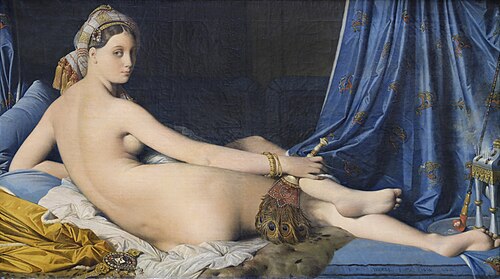
J.-A.-D. Ingres
La Grande Odalisque
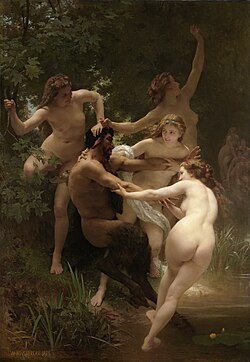
W.-A. Bouguereau
Nymphs and Satyr
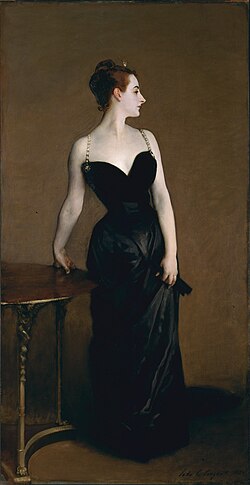
J. S. Sargent
Madame X
Drawing is the probity of art. To draw does not mean simply to reproduce contours; drawing is also expression, the inner form, the plane, modelling. J.-A.-D. Ingres
04The Russian line
A parallel tradition flourished in Saint Petersburg, where the Imperial Academy produced Bryullov, Ivanov, and above all Ilya Repin. Pavel Chistyakov, who taught Repin, Serov, and Surikov, codified a teaching method that survives in the Russian academic schools to this day. The Repin Institute in Saint Petersburg and the Surikov in Moscow remain among the very few institutions where the old course is still taught entire.
05Eclipse and revival
The collapse, c. 1920–1950
By the 1920s the academic system was in collapse almost everywhere. The First World War had shaken the cultural confidence of Europe; modernism had become the new orthodoxy of the art schools; and the slow patient discipline of the atelier was dismissed as reactionary. By 1950 there was scarcely a school in the Western world where you could learn to draw a cast or paint a head as your great-grandfather had.
The revival, 1950–today
That the chain was not quite snapped is owed to a small number of stubborn men. In Boston, R. H. Ives Gammell — a student of William Paxton, himself a student of Gérôme — kept the lamp lit through the dark middle decades. His students included Richard Lack, who founded Atelier Lack in Minneapolis in 1969. In Florence, Daniel Graves founded the Florence Academy of Art in 1991. Jacob Collins, in New York, founded the Water Street Atelier and later the Grand Central Atelier. Today there are perhaps thirty serious ateliers around the world — small, but alive.
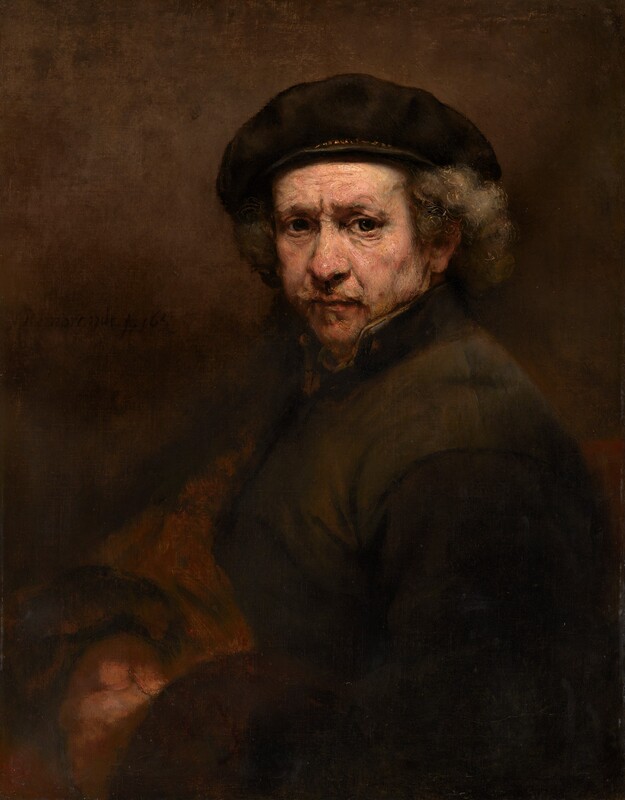
Rembrandt · Self-Portrait · c. 1659
06Ateliers teaching the method today
Florence Academy of Art
Founded by Daniel Graves in 1991. Branches in Florence, Jersey City and Gothenburg. The largest of the modern ateliers.
Charles H. Cecil Studios
Florence. The strictest of the sight-size schools, descended directly from the Boston atelier of R. H. Ives Gammell.
Grand Central Atelier
Long Island City, New York. Founded by Jacob Collins; the most influential American atelier of the revival.
Barcelona Academy of Art
A rigorous four-year programme drawing from both the Spanish and the Florentine traditions.
Studio Escalier
Paris and Argenton-Château. Run by Timothy Stotz and Michelle Tully, with a focus on figurative painting from observation.
London Atelier of Representational Art
Long-form full-time training in classical drawing and painting in the heart of London.
What “classical” means here
We use the word in its broad sense — the tradition of representational painting taught in the European academies from the 1600s to the 1900s, with roots in the Renaissance and the antique. It is not a synonym for Neoclassicism. Caravaggio is classical; so is Velázquez; so is Sargent. The method is the foundation, not the finish — a painter trained in it can work in any style.
Why this method, now?
An atelier trains the eye to see truthfully, the mind to measure, and the hand to obey. From that foundation, every style becomes possible. Without it, none can be sustained for long. The classical method is not a style — it is a discipline. It is slow, it is unglamorous, and it works.
The chapters that follow lay out the substance of the course. They are not a substitute for a master — nothing is — but they are an honest sketch of what the master would have you do, in the order he would have you do it.