Why drawing first
Painting is drawing with a brush.
Every problem you'll meet at the easel — proportion, structure, value, edge — is first a problem of drawing. If you skip this chapter you'll spend the next four years wondering why your paintings look wrong. The cure isn't more painting. It's more drawing.
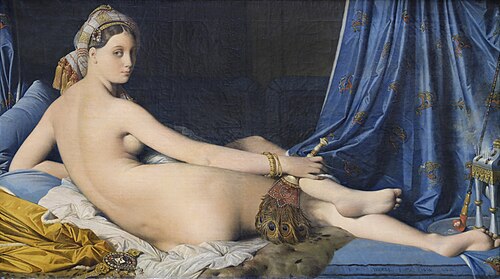
He who can draw can paint. He who cannot draw can never paint, though he live a thousand years. Ingres, to a pupil
01The three stages
The classical drawing course runs roughly three years of daily work, in this order:
The Bargue plates
Copy, line for line, the engraved drawings published by Charles Bargue from 1866. Learn to measure, construct, and see the abstract shape behind the apparent thing.
The plaster cast
Draw in graphite or charcoal from white plaster casts of classical sculpture. Render form in light without the distractions of colour or movement.
The living model
Long-pose drawing from the nude. Apply everything you've learned from cast and plate to the moving, breathing subject who never holds quite still.
02The Bargue course
Charles Bargue (1826–1883) was a French painter and lithographer who, with Gérôme, designed almost two hundred plates in the most progressive possible order. The earliest are a single shadow on a sphere; the last are full-length figures after the antique.
You copy each plate at the same size, attempting to match it exactly. Picasso copied the Bargue plates. So did Van Gogh. So did Gérôme's hundreds of forgotten pupils, who carried the discipline to the studios of America and South America.
Your tools: a sheet of smooth white paper the same size as the plate, a wooden drawing board, graphite pencils (HB, 2B, 4B), a sharp knife to point them, a kneaded eraser, and a plumb-bob on a length of black thread. Pin the plate beside the paper at arm's length, and stand at the drawing board to work.
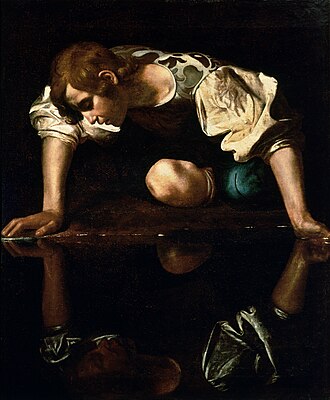
Caravaggio · Narcissus · c. 1599 · a study in the abstract pattern of light and shadow
03The block-in
Every Bargue plate — and every drawing thereafter — begins with a light construction of straight lines that establishes the largest shapes, their proportions, and their angles. You don't draw curves yet. A circle is drawn as an octagon. A head is a series of flat planes. A contour is a chain of straight segments.
Only when the abstract structure is correct do you start refining the segments into curves. Big to small. Straight to curved. Abstract to specific.
The plumb line
Hold a plumb-bob at arm's length before your eye and let it hang against the subject. The string gives you a true vertical. Compare every other line to it: this contour leans how many degrees from vertical? That feature falls plumb beneath which other? The plumb line and a level held between the fingers are the painter's only honest measuring devices.
04Cast drawing & the sight-size method
When you've copied thirty Bargue plates and your eye has begun to measure honestly, move to the plaster cast.
Set the cast under a single light source — a north window, or a 5000K bulb in a deep shade. Place your drawing paper on an easel directly beside the cast, so that when you step back to your viewing point (twelve to fifteen feet away) you see both cast and paper at the same scale.
This is sight-size: the drawing is made the same size as the cast appears to your eye at the viewing distance.
Why sight-size works
You can directly compare cast and drawing without your eye refocusing — any error in proportion is brutally obvious. And you can't “improve” the cast or stylise its proportions, because the comparison won't let you. You must record what you see, not what you know.
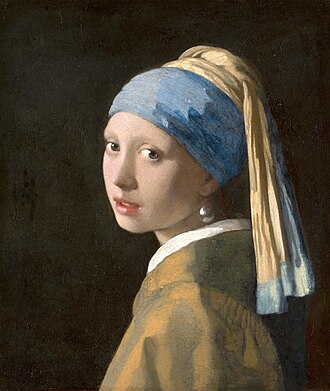
Vermeer · Girl with a Pearl Earring · c. 1665 · built on a foundation of drawing
05The stages of a cast drawing
- EnvelopeA light geometric block-in of the largest masses, established by plumb and angle, containing the whole cast in straight lines.
- Refinement of the block-inThe straight lines are subdivided into smaller segments. Segments compared one to another. Proportions tightened.
- Shadow shapesThe boundary between light and shadow (the terminator) is traced as a flat shape. Inside it, a single uniform halftone is laid down. You work in only two values: light (the white of the paper) and shadow (a single grey).
- Modelling within the lightHalftones are introduced into the light family. The lightest light — the highlight — is reserved.
- Modelling within the shadowReflected light is added where it appears, but never made as light as the lightest halftone. Shadows must remain shadows.
- FinishEdges softened or sharpened to match observation. Deepest accents placed. Surface unified.
06The two families of value
Among the most important habits the cast teaches is the rigorous separation of the light family from the shadow family. Every value on the cast belongs to one or the other.
No light value, however dark, should ever be as dark as the lightest shadow value. If reflected light in a shadow competes with halftones in the light, you've lifted the shadow out of its family — and the form goes flat. This is one of the most common mistakes in student work, and the cure is drawing many casts before you ever touch a brush.
Look first for the simplest large statement, then for the next simpler statement within that, and so on. The student who searches for detail before the structure is sound will spend his life shading eyelashes onto a head that is the wrong shape. Harold Speed
07What to draw, in order
The sphere & the cube
The two atomic forms. Draw them under directional light until you can render them with conviction.
Features in cast
The ear, eye, mouth, nose — after Michelangelo's David. The hand after Houdon. One per week, minimum.
The full head cast
The écorché head, then the heads of Niobe or the Belvedere Antinous. Each cast over two or three weeks.
The full bust
Now the head meets the torso. Shoulders, the turn of the neck, the meeting of clavicles and sternum.
What you'll need
Vine charcoal and willow charcoal · compressed charcoal pencils, soft to hard · smooth Bristol or Strathmore paper, 14×17 in. · a drawing board larger than the paper · a plumb-bob on 18 in. of black thread · a knitting needle for measuring distances · a kneaded eraser and a hard white plastic eraser · a small hand mirror, to see your drawing with fresh eyes.
From cast to model
When you can render a head cast convincingly in graphite or charcoal — not perfectly, but convincingly — you're ready for life drawing. The leap is smaller than it looks. The cast has been a motionless white model. The live model moves, breathes, and reveals all the warmth of the flesh. But the method — the block-in, the shadow shape, the two families of value — doesn't change. Honest work at the cast will carry you into the figure.