Start here
A handful of brushes, ten tubes of paint.
The materials of oil painting are few and have changed remarkably little since Jan van Eyck refined the medium in the early 1400s. A small set of pigments ground in linseed oil, a few bristle brushes, a thinner, a panel or canvas — this is everything. What separates a sound painting from an unsound one isn't the brand on the tube but knowing how each substance behaves wet, dry, and beside its neighbours.
01The support
You have two serious options: stretched linen or a rigid wooden panel.
Cotton duck, sold in volume at every art store, is best avoided. It stretches and slackens with the weather, accepts paint poorly, and ages badly.
Belgian or Irish linen, hand-primed with traditional oil ground, is the canvas of the masters.
Panel is unsurpassed for small studies — untempered hardboard coated with three thin layers of oil ground, sanded smooth between each. The Flemish painted on oak; today we use birch ply, MDF, or aluminium composite.
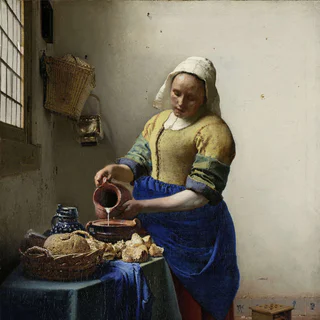
Vermeer · The Milkmaid · c. 1657 · painted on linen
02The brushes
You need three families. Don't buy more than you need; buy the best you can afford in each category.
Hog bristle
Stiff, long-wearing, indispensable for underpainting and large masses. The filbert is the most useful shape; flat next; round third. Buy sizes 2, 4, 6, 8, and 12.
Sable or synthetic
Soft, springy, holding a fine point. Used for finer drawing, small forms, and the final passes of glazing. Rounds in sizes 0, 2, 4, and 6 will see you through most work.
Mongoose or badger
A middling stiffness, useful for blending edges without disturbing the paint film. One broad badger blender is a luxury but worth the price.
Care
Wash brushes the moment you're done — first in solvent, then with soap and cold water, working the lather into the ferrule. A neglected brush is a ruined brush, and good brushes are not cheap.
03The oils & mediums
Linseed oil
The classical binder. Dries hard, forms the most durable paint film known. Yellows slightly with age — a flaw in whites, a virtue in flesh, which it warms agreeably. Cold-pressed for mixing; stand oil (heat-thickened) for mediums.
Walnut oil
Used by the Venetians and many Northern painters. Yellows less than linseed and dries more slowly, which the Flemish prized for blending.
Gum turpentine
Distilled from pine resin. Evaporates cleanly and bites slightly into the layer beneath, knitting the layers together. Buy rectified turpentine in dark glass.
Odourless mineral spirits
A refined petroleum solvent. Far kinder to the lungs than turpentine. Acceptable for cleaning brushes; serviceable, though inferior, as a paint thinner.
Damar varnish
A soft resin dissolved in turpentine. A few drops in the medium add gloss and transparency to glazes. Maroger and Flemish mediums are variations on this theme.
Stand oil
Linseed thickened by heat. Adds body and slows drying. Useful in glazing mediums where you want a slow, level film.
The single most important rule
Fat over lean. Each successive layer must contain more oil than the one beneath. Begin thin (paint with solvent only), end fat (paint enriched with oil or medium). A lean layer painted over a fat one will crack as the layer beneath continues to move. Pin this above your easel.
04The pigments
The Venetian and Flemish masters painted their greatest works with no more than a dozen colours — usually fewer. Start with a limited palette, learn it thoroughly, then expand. This is the standard classical palette:
Some painters add cadmium yellow, alizarin crimson, and cerulean. They aren't necessary at first. With just white, yellow ochre, Indian red, and ivory black — the so-called Zorn palette — you can paint a passable head from life. See the palette chapter for how to use these.
05The studio
North light
The classical studio is lit from a high north window — the steadiest and most neutral daylight in the Northern Hemisphere. If that's impossible, a 5000K bulb with high CRI will serve. The light should fall on the subject from a single direction, slightly above and to the side, casting a clear shadow.
Single source
Avoid mixed light sources at all costs. Warm tungsten mixed with cool daylight will ruin every colour judgement you make.
Neutral walls
The walls should be a neutral middle grey, neither warm nor cool. The easel should be heavy enough not to tremble at the brush. The palette — oak, mahogany, or glass — should be larger than you think you need.
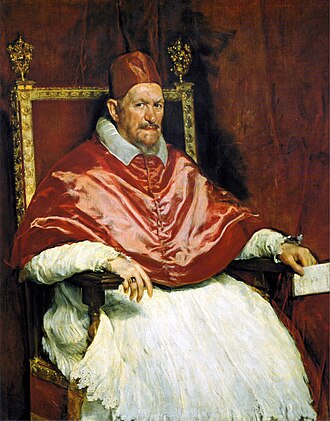
Velázquez · Innocent X · 1650 · painted under a single window
Safety
Several traditional pigments — lead white, the cadmiums, the cobalts — are toxic if ingested or inhaled as dust. Solvents are flammable; their vapours are hazardous in confined spaces. Keep the studio ventilated, never eat at the easel, wash your hands before leaving, and dispose of solvent-soaked rags in a sealed metal can. Linseed-oil rags will combust spontaneously if piled together.