Where everyone starts
The objects don't move. You can.
The still life is the painter's laboratory. The objects don't move, the light doesn't change, and you can study the same arrangement for weeks. Every problem the figure painter will face — form, value, edge, colour, surface, reflection — shows up in the still life in a form you can examine at leisure. From Chardin to Cézanne, every serious painter has returned to the still life their whole life. Every serious student starts there.
A pear and a copper kettle have taught me more than any model who ever sat for me. They do not move, and they do not flatter. Henri Fantin-Latour
01Setting up
A classical still life isn't a heap of objects — it's a composition designed on purpose. Three principles:
Limit the objects
Three or four is plenty for a first study. A single pear on a white napkin will keep you busy for a week if you paint it well.
One light source
One window, one bulb, or one spotlight. Never two competing sources. The shadows must agree.
Vary the surfaces
A reflective surface (a copper pot, a glass), a matte surface (bread, a clay jar), a soft form (a fold of cloth), and an organic form (fruit, a flower) make a complete teaching arrangement.
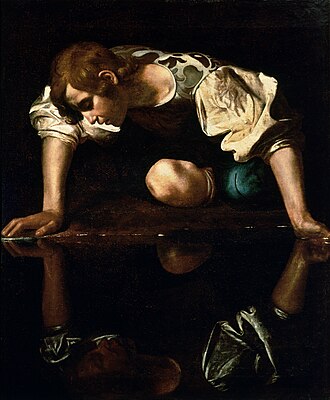
Caravaggio · Narcissus · c. 1599 · one light source, deep shadow, full focus
02The shadow box
The classical atelier paints its still life inside a shadow box — a three-sided wooden box, painted matte black inside, open at the front and one side (where the light enters). It does for the still life what the north window does for the figure: a controlled, directional light that isolates the objects from the visual clutter of the studio. Thirty inches deep by twenty-four high is ample for most arrangements.
03Composition
Before you mix any paint, make a thumbnail — a small sketch in pencil, at the size of a postage stamp, recording the largest light and dark masses and the placement of the objects within the frame.
It's your chance to discover the composition is dull before you've spent three days painting it. A thumbnail takes two minutes. Most beginners skip it; most beginners' compositions could have been saved by it.
Rules of thumb
- Odd numbers of objects read more naturally than even.
- Avoid placing the principal object dead centre.
- Leave breathing space at the top; weight at the bottom.
- Echo shapes: a round fruit pairs with a round bowl.
- Contrast textures: smooth metal beside crumpled cloth.
- Place the brightest accent away from the edge.
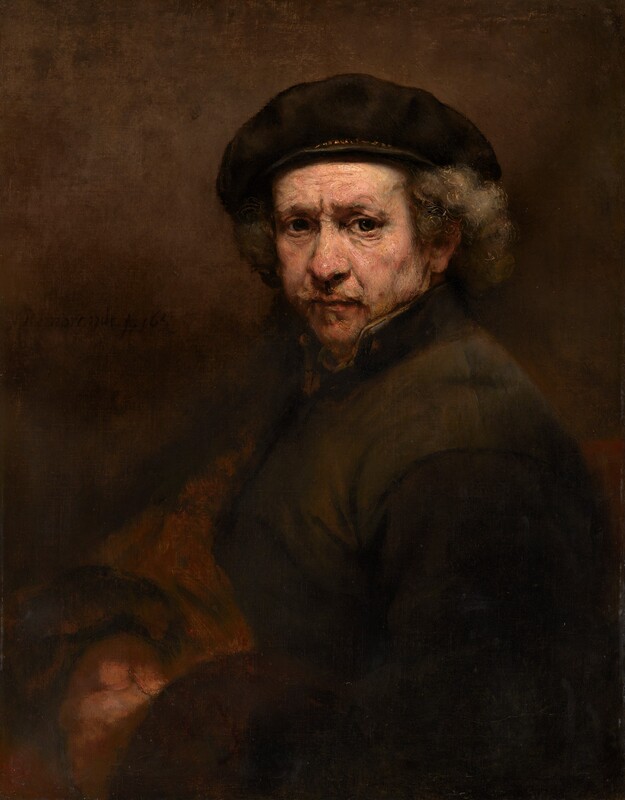
Chardin · Attributes of the Arts · 1766 · a master of arrangement
04Three problems to master
The plane of the table
Most still-life failures begin with a tabletop that doesn't sit honestly in space. Get its perspective right: the front edge is closer than the back, the plane recedes. Cast shadows obey the same vanishing point.
Reflective surfaces
A polished copper or silver vessel has no local colour. It shows you the room. Paint what you see, not what you know. The bright spot is the window. The warm glow is the table. The dark passage is the box's floor.
Transparency
A glass of water is a tissue of refractions, reflections, and edges. Look not at the glass but at the shapes you see through the glass — distorted, magnified, inverted. Paint those and the glass will appear.
Do not paint the apple. Paint the light striking the apple and the shadow cast by the apple. The apple will appear. William Merritt Chase
05A year's programme of studies
Work through this sequence and in twelve months you'll know more about painting than most people learn in a decade.
- Single egg, grisailleOne week. White egg on a white cloth. Just burnt umber and white. Get the form to round.
- Single white objectOne week. An egg, a piece of bread, a sugar bowl. Limited palette — Zorn.
- Single coloured fruitOne to two weeks. Against a neutral cloth. Full earth palette.
- A metal objectTwo weeks. Copper pot or brass candlestick on a coloured cloth.
- A glass vesselTwo weeks. Empty first, then half-filled with water.
- Three-object compositionThree weeks. Fruit, metal, cloth. The full classical method.
- Floral arrangementOne day. Alla prima, before the flowers wilt. Speed practice.
- A vanitasOne month. Skull, candle, book, hourglass. Every problem at once. Full layered process.
Useful objects for the studio
Vessels
A copper pot or kettle · a glazed clay vessel · a clear glass bottle · a cut-glass tumbler · a pewter or silver-plate spoon.
Fabrics & surfaces
Cream linen · dark velvet · a leather-bound book · a bone-handled knife · an old wooden cutting board.
Organic
Apples · pears · lemons · onions · garlic · a single rose · a skull (if you can obtain one honestly).
The vanitas
The vanitas — skull, snuffed candle, withered flower, ticking watch — was a meditation on the brevity of life. It's a great teaching subject because it forces you to handle every problem at once: organic and inorganic, smooth and rough, warm and cool, soft and hard. Paint one a year, every year of your painting life.
When you're ready for the head
When you can paint a satisfying still life of three or four objects, with their values in proper relation and their surfaces honestly rendered, you're ready for the head. The figure is harder, but only because it moves and because you care more about getting it right. The technical problems are the same: a head is a sphere lit from one side; a hand is a still life of five sausages. Onward.