The great subject
Everyone is an expert in faces.
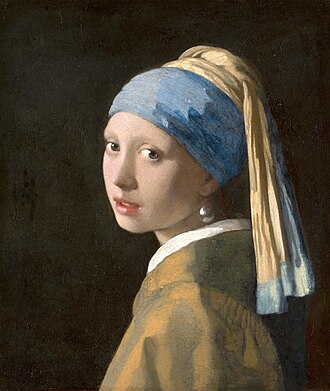
The painting of the human form has been the great subject of European art since the Renaissance, and the great test of the painter's training. Everyone alive has spent a lifetime looking at human faces; every viewer is therefore an expert in spotting a portrait that's “off,” even if they can't say why. If you've done your cast drawings, your still lifes, and your grisailles patiently, you've earned the right to take this on.
A portrait is a likeness in which there is something wrong about the mouth. John Singer Sargent
01Constructing the head
Before you can draw a head truthfully you have to understand it as a three-dimensional object. The classical method doesn't treat the head as a flat oval to be coloured in. It treats it as a sphere with flat planes carved into it — the planes of the forehead, the eye sockets, the cheeks, the planes of the nose, the jaw.
John Henry Vanderpoel's The Human Figure (1907) and Andrew Loomis's Drawing the Head and Hands (1956) are the two most useful guides in English.
The Reilly rhythms
Frank Reilly, who taught at the Art Students League, codified a method of constructing a head from a series of curving rhythms — the forehead and cheek of the shadow side, the brow ridge of the light side, the jaw line. Each is a definite curve, and you check your observation against the underlying construction. Learn to see Reilly's rhythms in every head and you'll rarely produce a portrait that's unrecognisable.
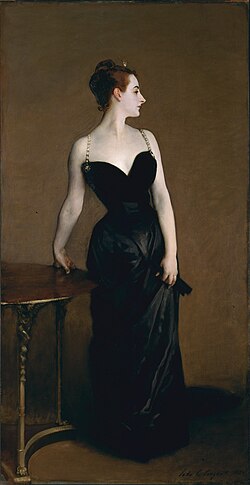
Sargent · Madame X · 1884 · the head turned three-quarters
02Proportions to know by heart
The classical canon, derived from antique sculpture and refined by the academies, gives proportions you should know by heart — not to apply as a formula, but to compare your observations against.
Width
The head, in front view, is roughly five eye-widths across. The space between the eyes is one eye-width.
Height of the eyes
The eyes sit at the midpoint between the crown of the head and the bottom of the chin — halfway down the whole head, not halfway up the face. Beginners place them too high.
The thirds
Brow to bottom of nose, and bottom of nose to bottom of chin, are roughly equal distances. The bottom of the lower lip falls halfway between bottom of nose and bottom of chin.
The ear
In profile, occupies the space between the brow line and the bottom of the nose.
These are averages
Every individual departs from the canon in a dozen small ways — and it's precisely these departures that are the likeness. You memorise the canon so you can see, by contrast, what's particular to the sitter in front of you. Longer nose, shorter chin, wider-set eyes — these are the portrait.
03The features, one at a time
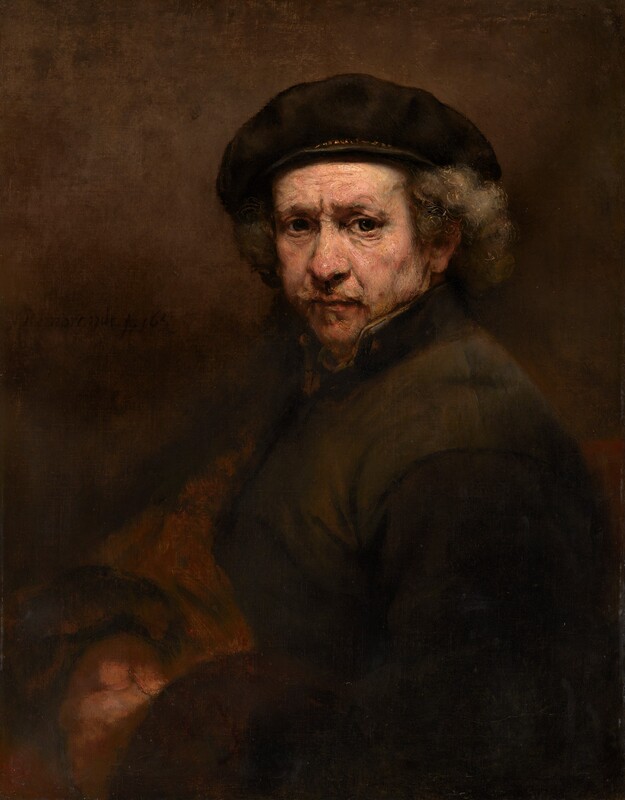
Rembrandt
Self-Portrait
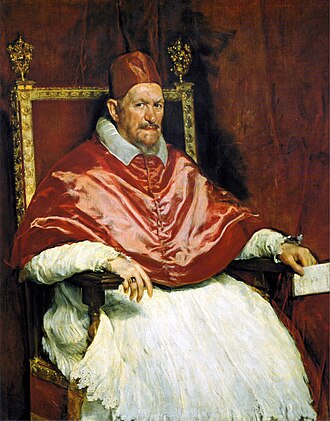
Velázquez
Pope Innocent X
The eye
The eye is not an almond pasted on a flat face. It's a sphere that sits in a socket, mostly hidden by the lids. The upper lid is thicker than the lower and casts a shadow on the white of the eye beneath; the lower lid catches a touch of reflected light. The white of the eye is rarely white — it's a warm grey in shadow, a cool grey in light, sometimes pink at the inner corner. The pupil and iris are circles, foreshortened into ellipses by the angle of view. The highlight on the iris is a tiny, sharp accent placed last.
The nose
Four planes: front, two sides, and bottom. Find the planes and the nose appears; smudge them together and the face goes flat. The bridge, where the side plane meets the front, is the sharpest line in the head. The wings of the nose, where the cartilage meets the cheek, are the softest. Vary the edge.
The mouth
The most expressive feature, and the most frequently bungled. The upper lip is darker than the lower because it's angled inward to the light; the lower catches light directly. The corners go back into the head as much as they go down or up — this is what makes a smile read as a smile. The line between the lips is never a hard contour: it's a series of soft and sharp passages, sharper at the centre, softer at the corners.
The ear
A sculpted form of remarkable complexity, easy to ignore and hard to render. Drawing one from cast once a month for a year will repay you many times over.
04The sitting
A portrait from life is painted in a series of sittings, each two to three hours, with breaks every twenty minutes for the sitter's comfort. Between sittings the painting dries; you can work on it alone, but the principal observation must be made from life, with the sitter in front of you.
The pose
Choose carefully — the sitter will hold it for many hours over many weeks. The head turned slightly off the body, the gaze meeting yours or fixed in middle distance — both work. Avoid extreme expressions; they can't be held. Aim for the natural, settled face the sitter wears at rest.
The light
A high north window, falling on the sitter from the front and slightly above, is the classical portrait light. It models the head clearly without throwing harsh shadows under the brows. Sargent worked this way; so did most of the academic portraitists. A spotlight at forty-five degrees with a fill bounce on the shadow side simulates it when the studio can't offer it.
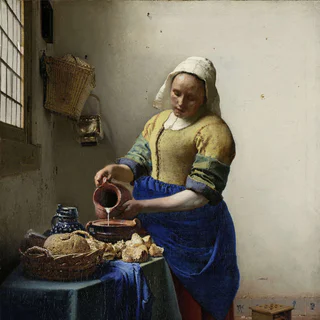
Vermeer · The Milkmaid · c. 1657 · classical north-window light
Painting the sitter, not the face
The greatest portraits aren't the most accurate. They're the ones in which the painter has caught something true about the sitter as a person — an intelligence, a wariness, a tenderness. You can't teach this directly. It comes only when the technique is sound enough to disappear, leaving you free to observe and respond. The discipline of the earlier chapters is the price of admission to that freedom.
05The figure
The full nude figure is the highest exercise in the academic curriculum and the test of every faculty you've trained. The drawing must be sound — the figure must stand or sit or recline on the ground convincingly. The anatomy must be felt — you know where the bones lie beneath the skin, and where the muscles attach. The light must be honest — the figure is a complex form, and the play of light over it obeys the rules of the sphere and the cylinder.
The classical nude is painted from life in a long pose — three weeks of three-hour sittings is a reasonable minimum. Same sequence as any other subject: imprimatura, drawing in paint, dead colour, working layer, glazing, accents.
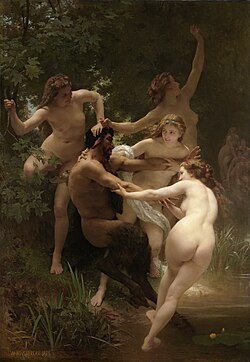
William-Adolphe Bouguereau
Nymphs and Satyr
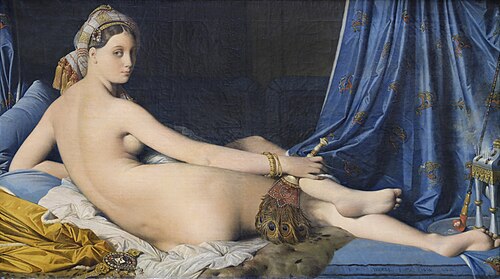
Jean-Auguste-Dominique Ingres
La Grande Odalisque
06Anatomy for painters
You don't need a surgeon's knowledge of anatomy. You need to know:
- The skeleton, in outline, and where each bone surfaces beneath the skin: the clavicles, the shoulder blade, the elbow, the wrist, the iliac crest, the patella, the malleoli.
- The major muscle groups and what they do: the pectorals, the deltoids, the biceps and triceps, the latissimus, the abdominals, the gluteals, the quadriceps, the hamstrings, the gastrocnemius.
- The classical proportions of the figure: roughly seven and a half heads tall, though the heroic proportions of antique sculpture run to eight or even nine.
- The line of action through the body, and the contrapposto — the alternation of weighted and free limbs that gives a standing figure its life.
Two books will give you everything you need: Stephen Rogers Peck's Atlas of Human Anatomy for the Artist (1951) and Gottfried Bammes's Die Gestalt des Menschen. Read them, draw from them, then forget them at the easel.
Know everything; forget everything; paint. Léon Bonnat, to John Singer Sargent